
Compost System
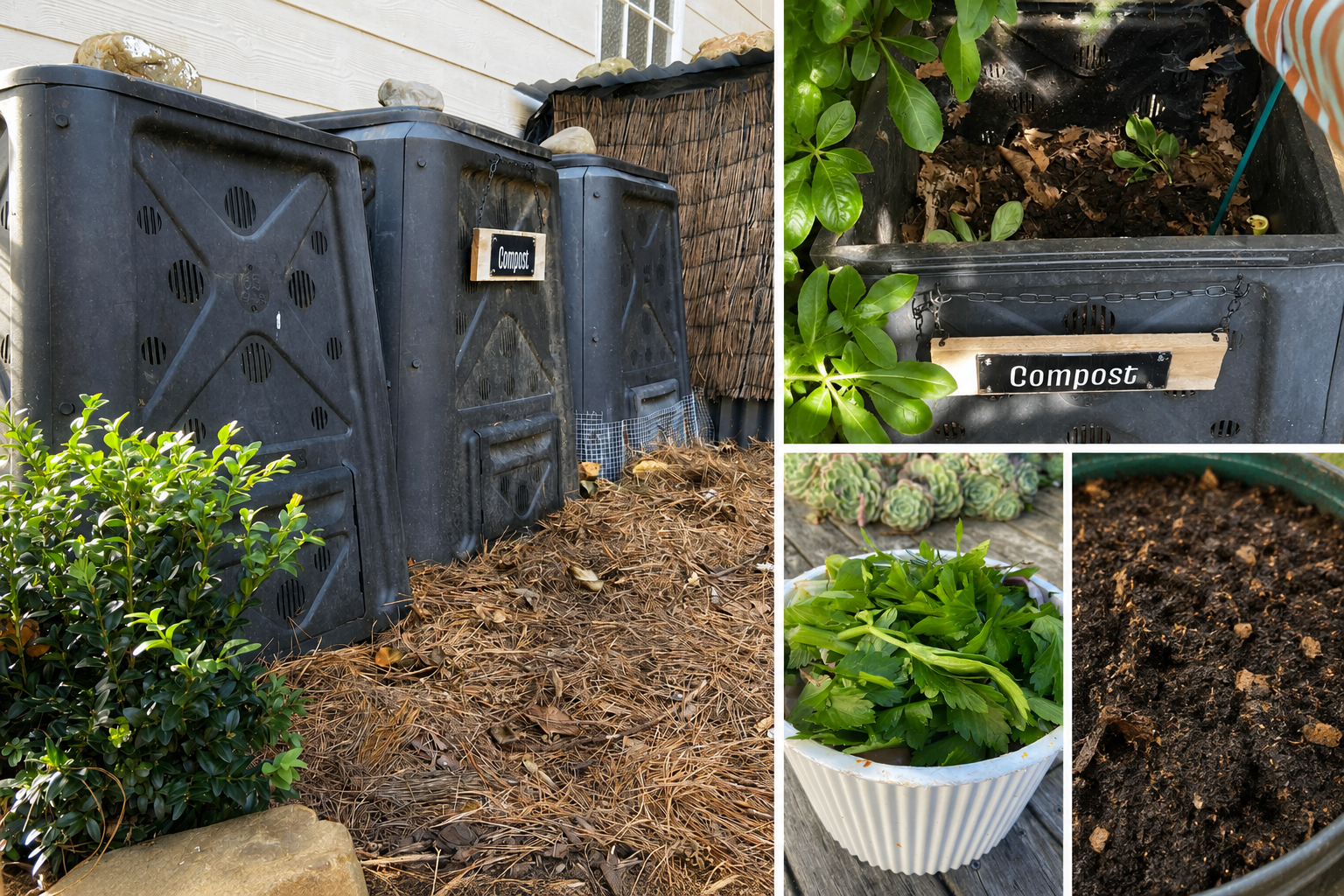
Three compost bins transform everyday organic materials into rich compost that feeds productive plants and keeps fertility cycling through the Seed to Sea garden.
The garden’s recycling centre
The Compost System at 38 The Parade is where many of the garden’s different activities come together.
Garden trimmings, fallen leaves, suitable kitchen scraps, cardboard, seaweed and materials from Hen Village are collected instead of being treated as waste. Microbes, fungi, worms and other decomposers gradually transform them into dark, crumbly compost.
The finished compost is returned to raised beds, fruit trees and other productive planting. It improves soil structure, helps the soil retain moisture and creates better conditions for soil life and plant growth.
This makes composting more than a way to manage scraps. It connects household activity, animal care, seasonal garden work and future food production in one continuing cycle.
How the system connects
The household and garden provide suitable food scraps, cardboard, leaves and plant material.
Hen Village contributes manure and used bedding.
Locally gathered seaweed adds another useful organic material.
Decomposers transform these materials into finished compost.
The compost returns nutrients and organic matter to productive soil, supporting future harvests.
A closer look: making compost
Successful compost needs a mixture of nitrogen-rich “green” materials and carbon-rich “brown” materials.
Green materials include fresh garden trimmings and suitable kitchen scraps. Brown materials include dry leaves, cardboard and used bedding. These are layered with enough moisture and airflow to support decomposition.
The material should be moist rather than saturated—often described as feeling like a wrung-out sponge. With air, moisture and time, the different ingredients break down and become a useful soil-building resource.
At a glance
Location: Composting area at 38 The Parade, Island Bay
Structure: Three black compost bins
System type: Organic-material recycling and soil-building system
Main inputs: Garden trimmings, leaves, suitable kitchen scraps, cardboard, seaweed, manure and used bedding
Working life: Microbes, fungi, worms and other decomposers
Main output: Finished compost
Garden use: Feeding raised beds, fruit trees and other productive planting
Role in the garden: Nutrient cycling, soil building, moisture retention and reducing organic material leaving the property
Permaculture principles: Produce No Waste; Catch and Store Energy; Use and Value Renewable Resources and Services
The Compost System shows how an ordinary urban garden can keep valuable organic materials in circulation—turning what might otherwise leave the property into fertility for future growth.
