
Worm Farm
Compost worms transform selected household food scraps, soft plant material and damp bedding into valuable vermicompost for the Seed to Sea garden.
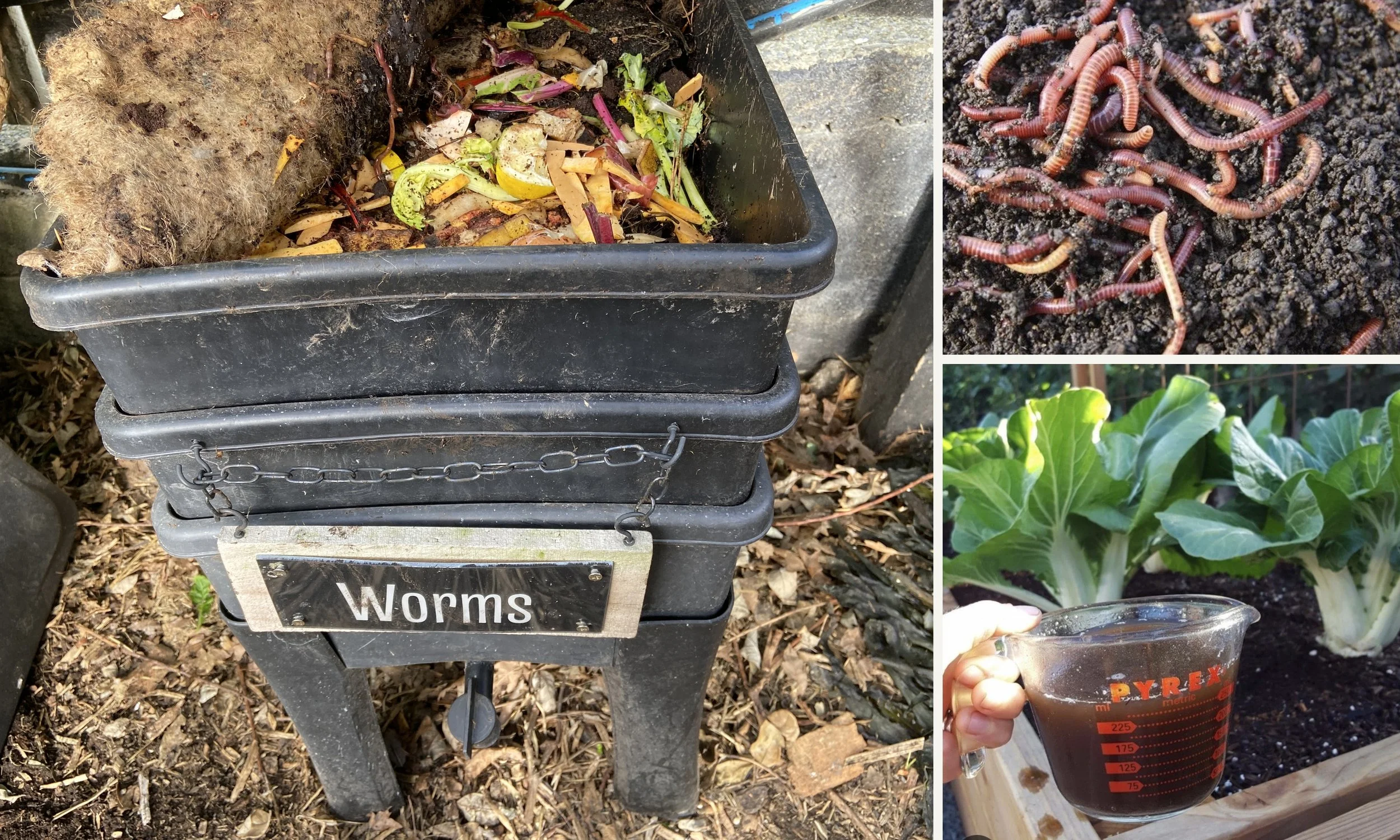
Where food scraps become living soil
The Worm Farm at 38 The Parade is a compact living system that connects everyday household activity with soil building and food production.
Suitable kitchen scraps and soft plant materials are added gradually, along with damp paper, cardboard and other fibrous bedding. Compost worms and microorganisms work together to break these materials down, producing dark, earthy vermicompost.
The finished material can be added to potting mixes, placed around productive plants or used when raising seedlings. Instead of leaving the property, selected food scraps become part of a living process that supports future garden growth.
The Worm Farm complements the larger Compost System. While the compost bins manage a broader range and greater volume of organic material, the worms provide a compact way to process selected soft scraps close to where they are produced.
How the system connects
The kitchen provides suitable fruit and vegetable scraps.
Paper, cardboard and other fibre provide bedding and carbon.
Compost worms and microorganisms break the materials down.
Finished vermicompost is harvested for pots, seedlings and productive beds.
Nutrients from household materials return to the garden and support future growth.
A closer look: caring for the worms
The worm farm is kept in a shady, sheltered part of the garden, away from direct sun and excessive heat.
The worms are fed manageable amounts so that food does not accumulate faster than the system can process it. Their bedding is kept damp and well aerated, creating suitable conditions for both the worms and the microorganisms involved in decomposition.
Caring for moisture, airflow, temperature and feeding keeps the system healthy and helps prevent unpleasant smells and unwanted pests.
At a glance
Location: Shady, sheltered area at 38 The Parade, Island Bay
System type: Compact vermicomposting and nutrient-cycling system
Working organisms: Compost worms, commonly Eisenia fetida, and microorganisms
Main inputs: Suitable kitchen scraps, soft plant material and damp fibrous bedding
Supporting materials: Paper, cardboard and other suitable carbon-rich fibre
Main output: Finished vermicompost or worm castings
Garden use: Potting mixes, seedlings and productive garden beds
Management: Regular light feeding, moisture and airflow control, and protection from heat and direct sun
Role in the garden: Household nutrient cycling, soil building and demonstrating decomposition
Permaculture principles: Produce No Waste; Obtain a Yield; Use and Value Renewable Resources and Services
The Worm Farm shows how some of the garden’s smallest inhabitants perform essential work—turning everyday household materials into a resource for living soil and future harvests.
